What to Expect at the Top of Christ the Redeemer
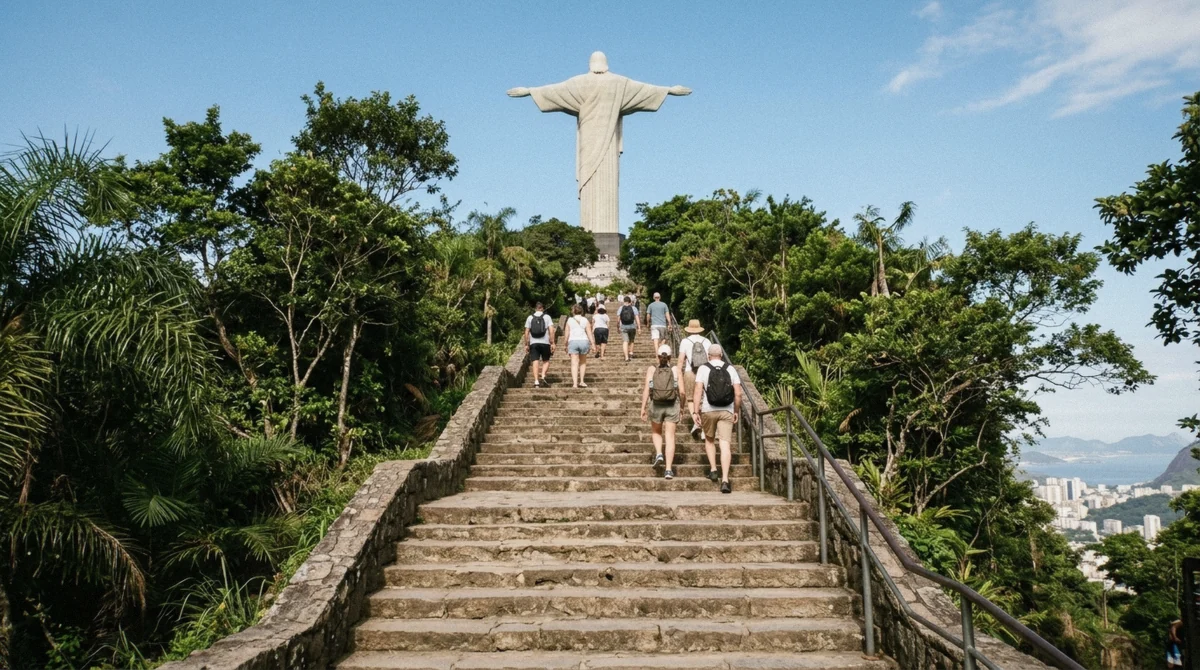
You'll arrive by train or van at the base of the plateau and then climb, because as of August 2026 the escalators that used to carry visitors the last stretch are being rebuilt: expect 220 steps total from the arrival area, the final 80 of them stone stairs up to the statue itself. That works alone are worth planning around, not a reason to skip the trip. Once you're up there, the reward is the same one every visitor comes for: the 30-metre statue at close range, sweeping views over Guanabara Bay and the city below on a clear day, a working chapel, and a plateau that feels smaller and busier than photographs suggest. We've walked this route more times than we can count, watched the works crew arrive in August, and written down exactly what changes for a visitor right now and what has stayed the same for decades. For the practicalities of getting up here in the first place, see how to get to the top of Corcovado, and for how to photograph what you find, see our photo spots guide.
Quick answer
As of August 2026, expect a climb rather than an escalator ride: 220 steps in total from the arrival level, the last 80 of them stone stairs up to the plateau, while the site's four original escalators are replaced and two new panoramic elevators are added, a project the park authority says will run through the end of May 2027. Once you're up, allow a good 45 minutes to an hour at the statue itself for the views, the chapel, and photos, more if you want to wait out cloud.
Key takeaways
- The stairs are temporary: works began 3 August 2026 and are due to finish by the end of May 2027, after which escalators are meant to carry up to 6,000 people an hour
- Reduced-mobility visitors aren't left out: five stair-climbing wheelchairs and five carriers for a visitor's own chair run during the works, in dry conditions only
- The entry ticket by cog train still gets you to the base of the climb the same way it always has, just with stairs at the top instead of escalators
- Drones are banned outright at the summit, and the Laudato Si' chapel is a no-photography zone, both worth knowing before you plan your visit down to the minute
- The statue itself is 38 metres tall counting its pedestal, a scale that's easy to underestimate until you're standing at its base looking up
- Combining the climb with the Selarón Steps in one outing is a common pairing; see our half-day pairing if that appeals
Tours That Get You to the Top
Every one of these bundles transport, your dated entry slot, and a guide who already knows the current stair situation, so you're not working it out on the spot.
 from $48
Most Popular — 5,026 Reviews, 4.4★
from $48
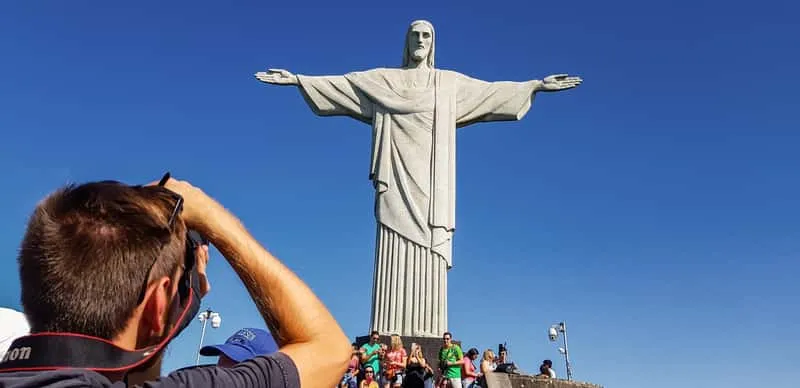
Most Popular — 5,026 Reviews, 4.4★ Christ the Redeemer Entry Ticket by Corcovado Train
The official Christ the Redeemer entry ticket including the scenic Corcovado cog train ride up through Tijuca National Park, the world's largest urban forest. Ride the historic electrified…
- Official Christ the Redeemer entry ticket included
- Scenic cog train ride through Tijuca Forest National Park
- Unique views of Sugarloaf Mountain and Guanabara Bay
- Access to the Christ the Redeemer Museum and Visitors Center
 from $60
4.4★ — 170 Reviews
from $60
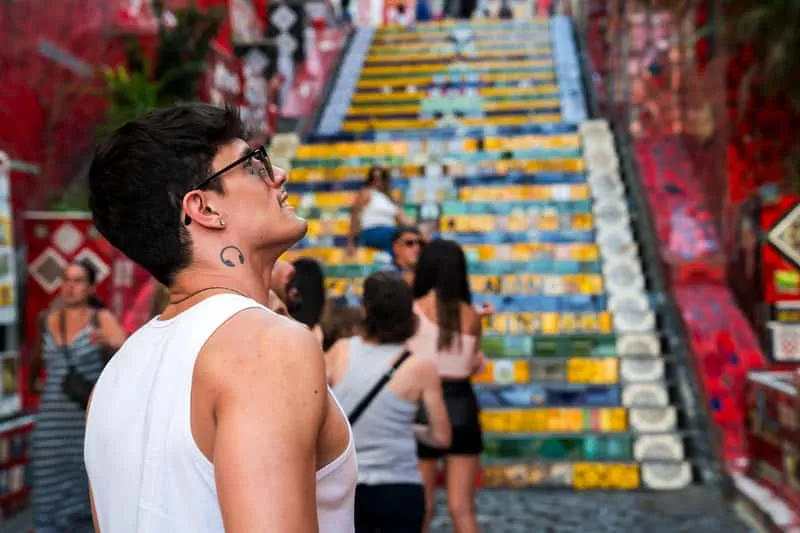
4.4★ — 170 Reviews Christ the Redeemer & Selarón Steps Half-Day Tour
A guided half-day tour to Christ the Redeemer at the top of Corcovado Mountain, 710 meters above sea level, followed by the world-famous Selarón Steps and the artsy…
- Visit Christ the Redeemer, a New Seven Wonder of the World
- Panoramic views of the city from atop Corcovado Mountain
- See the world-famous Selarón Steps mosaic staircase
- Drive through the historic Santa Teresa neighborhood
 from $130
Top Rated — 4.6★
from $130
Top Rated — 4.6★ Christ the Redeemer & Sugarloaf Half-Day Tour
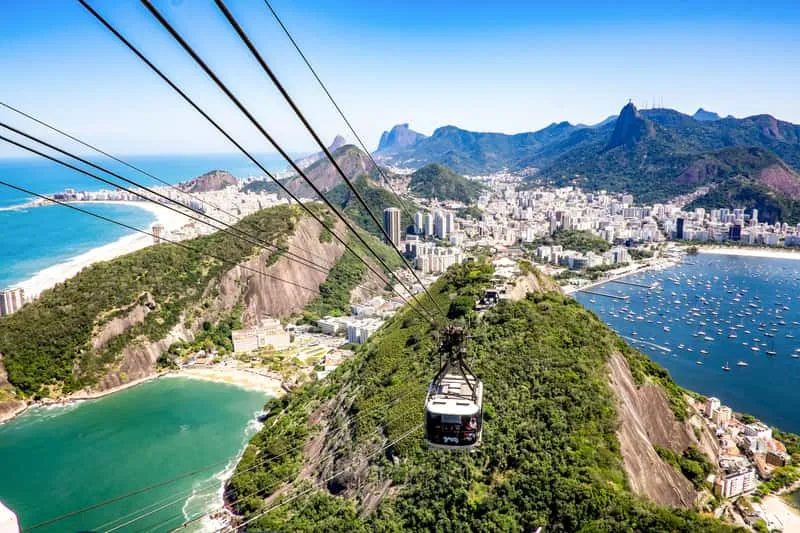
A guided half-day tour combining Rio's two most famous landmarks: the Christ the Redeemer statue on Corcovado Hill and the Sugarloaf Mountain cable car. Arrive early to beat…
- Visit Christ the Redeemer and Sugarloaf in one half-day
- Arrive before the crowds at both landmarks
- Ride the Sugarloaf cable car for panoramic bay views
- Small group tour, maximum 19 people, with hotel pickup
From Arrival to the Plateau, Step by Step
Whether you come up by train or van, the walk from the arrival level to the statue follows roughly the same shape right now. Times vary by how busy your slot is, so treat these as the order of things rather than a stopwatch.
-
First few minutes
You step off the train or van at the arrival level
This is where the queue for the climb starts. Signs point toward the stairs; the old escalator housings are visible but closed off for the works.
-
About five minutes in
The first flight of stone steps
Part of the 220-step total from here to the plateau. There's a landing partway up where most people pause; it's not a race and nobody expects it to be.
-
About ten minutes in
You reach the second level
A wider platform with the first real payoff view over the forest and bay. This is also where the stair-climbing wheelchairs and carriers stage for visitors who booked that assistance.
-
The final stretch
The last 80 stone steps to the plateau
Steeper and narrower than the lower flights. Handrails run the length of it. Most visitors take this section slowly, and that's normal, not a sign anything is wrong.
-
You're up
Out onto the plateau at the statue's base
The crowd opens up and the full 38-metre statue is suddenly right above you. Give yourself a minute here before you start working out where to stand for photos.
The Stairs Right Now: What the Works Changed
Escalator replacement works at Alto do Corcovado began on 3 August 2026 and are expected to run through the end of May 2027, according to Tijuca National Park, the park authority that manages the site, cross-checked against the cog train operator's own page. Four escalators that had been in service since 2003 are being removed and replaced, and two inclined panoramic elevators are being added for accessibility, a genuine upgrade once finished rather than a like-for-like swap.
The monument stays open the whole time the works run; trains, vans and the walking trail all keep operating. What changes for a visitor today is the last stretch on foot: 80 stone steps from the second level up to the plateau, 220 steps in total counting the lower flights from the arrival area. There's no way around them right now, so build a few extra minutes into your plan and wear shoes you're comfortable climbing in.
The works also cut maximum simultaneous capacity at Alto do Corcovado by 50%, and that limit applies across every arrival method, train, van and trail alike. In practice that means the plateau feels less crowded at any given moment than it used to, but it also means slots can fill and queues at the base of the stairs can build during the busiest hours.
The stated goal once the new escalators and elevators are running is to move up to 6,000 people an hour through the site, well above what the stairs alone can manage. We treat that as the operator's stated target for the finished system rather than a promise about exactly what happens the day the works wrap, and we'll update this page as the completion date approaches.
Accessibility and Reduced Mobility
For the duration of the works, the site runs five automated stair-climbing wheelchairs, rated to 130 kg, and five stair-climbing carriers built to take a visitor's own standard wheelchair, rated to 150 kg. Both are staffed by attendants who guide the climb; the reported timing is about 8 minutes on the way up and about 6 minutes coming back down.
One real limitation worth knowing before you plan around it: this equipment only operates in dry conditions. A wet stone stairway isn't safe for it, so on rainy days the option isn't available and visitors who need it should have a backup plan, or simply travel on a day with a settled forecast if that's possible for your trip.
If step-free access matters more than anything else on your visit, it's worth contacting the operator directly ahead of your date to confirm current arrangements, since equipment availability and staffing can shift as the broader works progress through 2026 and into 2027.
What You Can See from the Terraces
On a clear day the view from the plateau runs out over Guanabara Bay, the curve of Botafogo and Flamengo beaches, Sugarloaf Mountain rising on its own granite dome, and the sprawl of the city stretching toward the hills on the far side. It's a genuinely wide panorama, not a single postcard angle, and it's worth walking the full width of the viewing area rather than shooting from the first spot you find.
We won't promise you that view, because we can't. The summit sits at 710 metres and is genuinely, frequently in cloud; there's no official webcam and no way to check conditions up there before you commit to your slot. Morning is generally your best odds, and July and August tend to run drier and clearer than the December to January stretch, but any given day can go either way.
If the cloud is in when you arrive, give it twenty or thirty minutes; it can burn off while you're still up there.
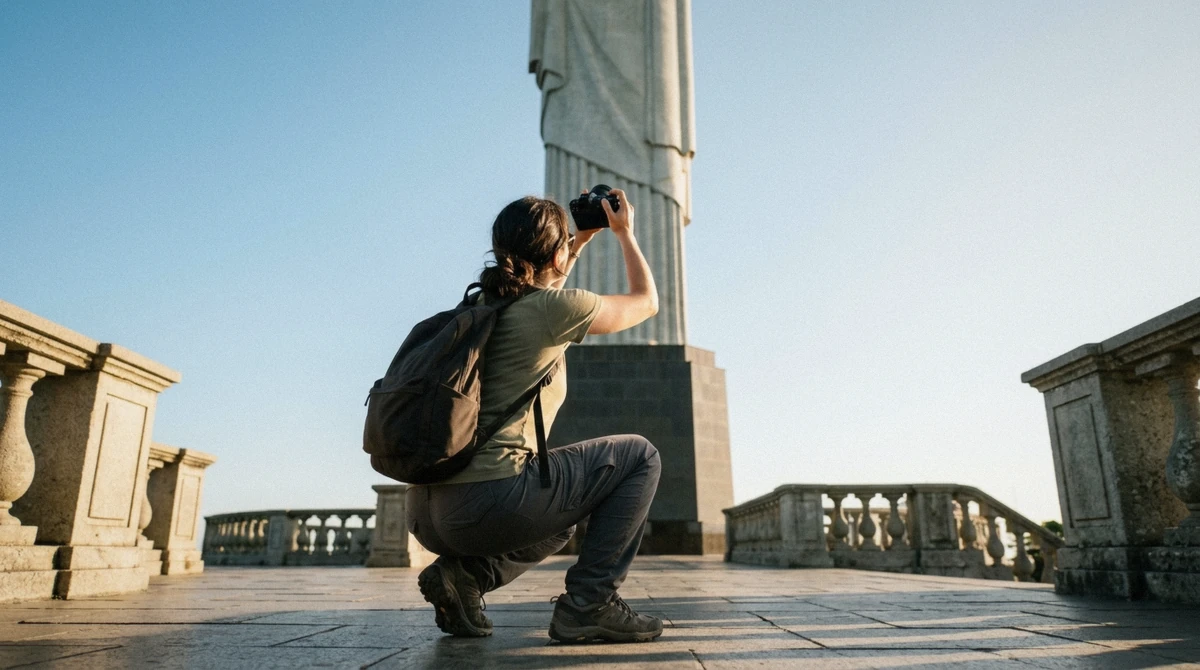
For the honest run-down of which vantage points work best and when to shoot them, our photo spots guide covers the terraces in more detail than we'll go into here.
The Statue in Numbers
Scale and construction
The statue itself stands 30 m tall on an 8 m pedestal, 38 m in total, with an arm span of about 28 m. It was completed in 1931, sculpted by the French-Polish artist Paul Landowski, with Brazilian engineer Heitor da Silva Costa driving the project and French engineer Albert Caquot contributing to the structural design. The face was sculpted separately by the Romanian sculptor Gheorghe Leonida.
The mountain and its status
Corcovado's peak sits at 710 m above sea level, inside Tijuca National Park, managed by ICMBio. The statue was named one of the New7Wonders of the World in a public vote run by the New7Wonders foundation in 2007, which is a popular accolade rather than an official heritage designation. The actual heritage status comes separately: the whole setting lies inside the UNESCO World Heritage site "Rio de Janeiro: Carioca Landscapes between the Mountain and the Sea," inscribed in 2012.
| Measure | Figure | Worth knowing |
|---|---|---|
| Statue height | 30 m | Taller than a nine-storey building, which is why a low angle is the only way to fit it in one frame |
| Pedestal | 8 m | Bringing the whole monument to 38 m |
| Arm span | About 28 m | Almost as wide as the statue is tall |
| Summit elevation | 710 m | High enough to sit in cloud while the beaches are in sun |
| Completed | 1931 | Sculpted by Paul Landowski, engineered by Heitor da Silva Costa, the face by Gheorghe Leonida |
| Named a New7Wonder | 2007 | A global public vote, separate from the UNESCO listing |
| UNESCO listing | 2012 | As part of Rio de Janeiro: Carioca Landscapes between the Mountain and the Sea |
The Chapel and the Rest of the Summit
In the base of the statue is a small chapel dedicated to Nossa Senhora Aparecida, Brazil's patron saint. It's a working chapel rather than a museum piece; visitors are welcome to step in quietly. This is an active place of worship as much as it is a viewpoint, and we'd ask you to hold that in mind when you're up there, especially around anyone praying.
There's also a snack bar, a souvenir shop and restrooms at the summit, useful to know if your visit runs longer than planned or you need a break partway through the climb back down. We won't quote you prices or a menu here since both change; treat them as there when you need them rather than part of the plan.
The Rules at the Monument
Drones are strictly forbidden during visiting hours, a rule the Sanctuary states plainly for reasons of security, preservation of the site and respect for other visitors and worshippers. Leave it packed away or at the hotel; there's no exception for a quick shot.
Photography is not allowed inside the Laudato Si' perpetual-adoration chapel at the summit. It's a small, quiet space set aside from the main viewing areas, and the no-photography rule holds even if nobody's actively praying when you pass through.
Beyond those two, treat the plateau the way you would any crowded public monument that also happens to be sacred ground: keep noise reasonable, don't climb on the barriers for a better angle, and give the chapel space to people using it for its actual purpose.
How Long to Allow
Plan on 45 minutes to an hour at the summit itself once you've made the climb, longer if you want to wait out cloud or if the plateau is busy and you'd rather let a wave of visitors move through before you settle on your photo spots. Add the climb itself, currently the 220 steps from arrival to plateau, plus the ride up and back on whichever transport you chose.
A blessing runs between 7:30 and 8:00 each morning before the plateau opens fully to visitors, worth knowing if you're booked on one of the earliest slots of the day. We can't give you a hard closing time for the monument, because the sources that publish one don't agree with each other; the slot you actually book carries the schedule that counts, so treat what you see at checkout as final rather than anything printed elsewhere, including here.
At about R$5.18 to the dollar in August 2026, most visitors treat this as a half-day outing once transport, the climb, and time at the top are all added together, longer if you're pairing it with Sugarloaf or the Selarón Steps in the same trip. If a dated cog-train slot is the only piece you still need, our cog train entry ticket page breaks down that option on its own. Last verified: August 2026.
How the Options Compare
If you'd rather see the choice laid out plainly than piece it together from separate pages, here's how the four options we compare stack up on price, time, and what's actually included. All four get you to the same statue and the same climb described above; the difference is what else comes with the trip.
| Option | Price | Duration | What's included |
|---|---|---|---|
| Cog train entry ticket | $48 | valid 1 day | Return train ride and monument entry, no guide |
| Christ the Redeemer and Selarón Steps | $60 | 3 hours | Train or van up, guided time at the summit, plus the Selarón Steps |
| Explore Rio: Christ the Redeemer, Selarón and Maracanã | $69 | 5 hours | All three stops in one guided outing; note the operator rating here is from only 7 reviews so far |
| Christ the Redeemer and Sugarloaf | $130 | 5 hours | Both summits in one day, guided, transport between them included |
Worth saying plainly: the official cog train fare bought directly from the operator runs R$134, about $26 at the rate above, and includes the same ride up, ride down and monument entry as the $48 ticket in that first row. The higher price on our list reflects the booking and guide convenience layered on top, not a markup on the same product; readers after the lowest possible entry cost can buy directly from the train operator instead.
Frequently Asked Questions
Are the escalators at Christ the Redeemer working right now?
No. As of August 2026 they're being replaced, a project running through the end of May 2027, and visitors climb 80 stone steps from the second level to the plateau in the meantime. See entry tickets by cog train for a booking that already accounts for the current climb.
How many steps are there at Christ the Redeemer?
220 steps in total from the train and van arrival area up to the plateau, with the final 80 of those between the second level and the statue itself, while the escalator works continue.
Is Christ the Redeemer wheelchair accessible during the works?
Partly. Five automated stair-climbing wheelchairs rated to 130 kg and five stair-climbing carriers rated to 150 kg run during the escalator replacement, taking about 8 minutes up and 6 minutes down, though they only operate in dry conditions.
Can you fly a drone at Christ the Redeemer?
No. Drones are strictly forbidden during visiting hours, a rule stated by the Sanctuary itself for security, preservation and respect for worshippers and other visitors.
How long should you spend at Christ the Redeemer?
Allow 45 minutes to an hour at the summit itself once you've reached the plateau, on top of transport and the climb. Tours like the Selarón Steps pairing build that timing into a half-day itinerary already.
What is there to do at the top of Christ the Redeemer?
The main draw is the statue and the panorama over Guanabara Bay, Sugarloaf and the city, plus a small working chapel dedicated to Nossa Senhora Aparecida, a snack bar, and a souvenir shop.
Is the view from the summit guaranteed to be clear?
No. The summit sits at 710 metres and is genuinely often in cloud, with no official webcam to check beforehand. Mornings and the drier months from May to October generally give better odds, but no operator or guide can promise a clear day.
None of this is meant to talk you out of the trip; it's meant to set you up for the version of it that's actually happening right now, stairs and all, so the climb doesn't come as a surprise partway up. The statue, the chapel and that view have outlasted plenty of construction projects before this one, and they'll still be waiting at the top once the new escalators are running. If you haven't booked yet, entry tickets to the Corcovado plateau are the natural next step.